




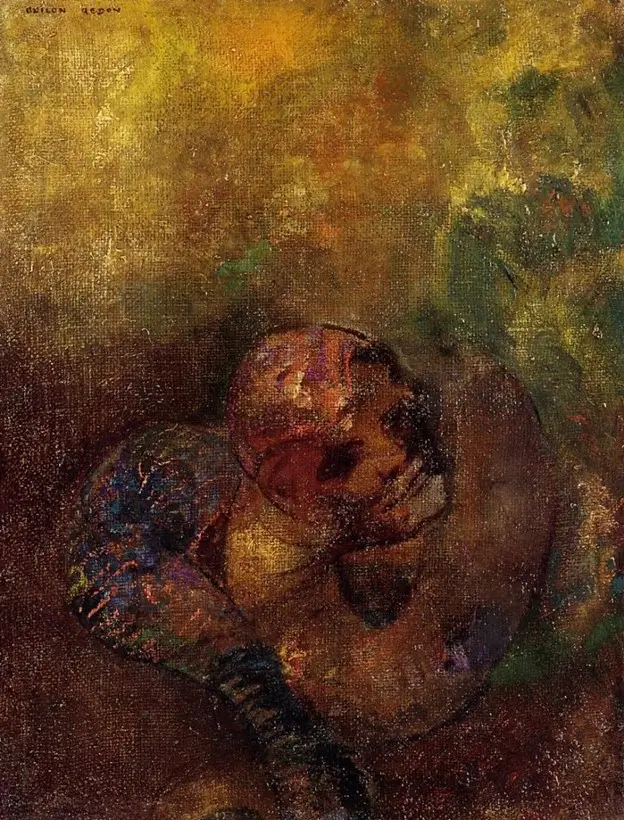
Fig1. Odilon Redon (1840–1916), Chrysalis, Oil on canvas, Private Collection; date unknown [Image Reference] – psychic birth
Author: Farhad Radfar
Audience: Therapists, psychoanalysts, perinatal and early-development specialists, and parents interested in understanding fetal experience and its impact on emotion and the parent–child relationship
Reading time: 4–5 minutes
Psychic Birth: The Gradual Emergence of the Human Mind
The question of when the inner world of a human being begins is not one that can be answered solely by pointing to the moment of birth. The mind, contrary to what outer life may suggest, is not suddenly born at a single bright point in time; rather, it takes shape along a hidden, gradual, and often invisible path—a continuum that begins in the womb, becomes inscribed in the body, and later comes alive in the first encounters with language, relationship, and the gaze of another. In the opening pages of Inside Lives, Margot Waddell emphasizes precisely this point: that psychic birth cannot be reduced to the physical event of birth. She shows that although these two moments intersect, they are neither simultaneous nor synonymous. Physical birth is abrupt and discrete; psychic birth, however, is a slow and continuous process that begins before birth and extends long after it.
Prenatal Experience and the Hidden Architecture of the Psyche
Freud, a century ago, warned against treating birth as the absolute beginning of mind. He believed that the infant enters the world already marked by “pre-experiences”—imprints that have no language yet, but live in the body and later form part of the architecture of the psyche. This perspective paved the way for researchers such as Alessandra Piontelli, whose meticulous ultrasound observations and longitudinal follow-ups demonstrated that fetal life is not a pre-psychological biological phase, but an integral part of an individual’s psychological history. The fetus is not merely a body; it is responsiveness, sensitivity, relationality—and, at times, the silent bearer of losses no one else knows.
Clinical Illustration: Jacob and the Process of Psychic Birth
The story of Jacob, the eighteen-month-old child described by Piontelli, is a clear example of this “hidden architecture of the psyche.” His exhausted and distressed parents brought him to therapy, worn down by continuous sleeplessness, relentless restlessness, and the intense anxiety that surged with each developmental milestone. Jacob moved ceaselessly around the room, as if searching for something he had lost. He shook objects, as though needing to reassure himself they were still alive. What appeared senseless to the parents carried meaning for the child’s body—meaning that had not yet found its name. When Piontelli gently said, “It seems you’re looking for something you can’t find,” Jacob paused for the first time. He stopped, looked, and something within him registered the words. When the therapist added, “It’s almost as if things that stop moving feel like they are dead to you,” his parents burst into tears and revealed what had remained unspoken until that moment: Jacob had been a twin. His co-twin—whom they had planned to name Tino—had died in the womb two weeks before birth. Jacob had spent the final two weeks of gestation beside the unmoving body of his brother—a raw, immediate, wordless experience. An experience not consciously understood, not encoded in explicit memory, but held in the body and rewritten in the earliest expressions of his life.
Psychic Birth and the Encounter with Early Loss
His anxiety at each developmental step—sitting, crawling, walking, even speaking his first word—was not fear of change, but fear of repeating an early loss he had once lived beside. For him, every “step forward” equated to “leaving someone behind”—as though growing meant becoming alone, surviving meant being responsible for another’s death, and development itself meant betraying the silent co-existence he had shared with his still twin. Jacob’s nameless terrors originated from that point in the darkness of the womb, where the psyche had no words but the body recorded everything.
Conclusion
The moment that silent bodily experience found its signifier—when the mute signified of his early bodily memory entered the symbolic order—something within Jacob shifted. What had existed only as restlessness, tension, and unformulated fear finally gained a place in the chain of meaning; the body’s silence, at last, found its language. From that moment, change began. His restlessness decreased, his sleep improved, and the endless search that animated his movements quieted. This act of naming was itself a psychic birth—the birth of meaning for an experience that had lived wordlessly in the recesses of his body. Such cases make it clear that psychic birth is not an instantaneous event; it is a form of unfolding that emerges from continuity. The psyche is forged on the border between embodied life, relationship, and language. Early losses, however unseen, become part of its structure. And only through connection with another—through being heard, named, and witnessed—can these early wounds transform from “raw injuries” into bearable elements of personal history. The mind experiences life long before it is born; the body knows before language arrives. And the psyche is born at the moment when what took shape in the silence of the womb finally finds meaning in the presence of another.
[Read More: Nameless Ghosts: How an Unbearable Past Casts Its Shadow on the Present]